

Emma Willard (née Hart; February 23, 1787 – April 15, 1870) was a pioneering American educator, women's rights advocate, author, and cartographer. Born in Berlin, Connecticut, as the 16th of 17 children in a family that unusually valued education for daughters as well as sons, she became one of the most influential figures in advancing female higher education in the United States.
Early Life and Career
Encouraged by her progressive father, Emma pursued academics beyond what was typical for girls at the time. She began teaching as a teenager, heading academies in Connecticut, Massachusetts, and Vermont. In 1807, she became principal of a female academy in Middlebury, Vermont. There, observing the superior education offered to men at nearby Middlebury College (including through her husband's nephew), she self-taught advanced subjects like geometry and philosophy.
In 1809, she married physician John Willard (much older, with children from a prior marriage). Financial needs led her to open a girls' boarding school in her home in 1814, where she introduced rigorous academics typically reserved for boys.
Key Achievement: Founding Troy Female Seminary
In 1819, Willard published her influential pamphlet "An Address to the Public; Particularly to the Members of the Legislature of New-York, Proposing a Plan for Improving Female Education", advocating for women's access to the same subjects as men (math, science, history, etc.). Supported by figures like Governor DeWitt Clinton, she moved to New York.
In 1821, she founded the Troy Female Seminary in Troy, New York—the first U.S. institution offering higher education to women on par with men's colleges. It emphasized science, mathematics, and social studies, pioneering methods that influenced later schools (predating Mount Holyoke by years and public girls' high schools). Thousands of women were educated there during her lifetime.
The school thrives today as the Emma Willard School, a prestigious all-girls college-prep boarding and day school (grades 9-12) on a historic campus.
Other Contributions and Works
Willard authored popular textbooks and innovative educational materials, including:
- History of the United States, or Republic of America (1828)
- A System of Universal History in Perspective (1835)
- Guide to the Temple of Time; and Universal History for Schools (1849)
- Astronography; or Astronomical Geography (1854)
She pioneered creative teaching aids, like tree-like historical timelines and maps to visualize chronology.
Her poem "Rocked in the Cradle of the Deep" remains well-known. She also advocated for coeducation and represented the U.S. at international educational forums.
Historical Timelines and Maps
Emma Willard pioneered innovative visual aids for teaching history, transforming abstract chronology into engaging, spatial representations. She believed visuals helped students grasp time more intuitively than text alone, often blending perspective, geography-like mapping, and symbolism. Her works appeared in textbooks, atlases, and large classroom charts from the 1820s to the 1850s.
Key Innovations in Timelines and Maps
Perspective Sketches and "Maps of Time": Willard treated time as a three-dimensional landscape. In her 1836 "Perspective Sketch of the Course of Empire" (from the Atlas to Accompany a System of Universal History), history flows toward the viewer like rivers or mountain ranges converging from ancient times (biblical Creation at the distant apex) to the present. Civilizations rise and fall, connected or isolated, emphasizing an "ancestry of nations" with events like Christ's birth or America's discovery as pivotal markers.
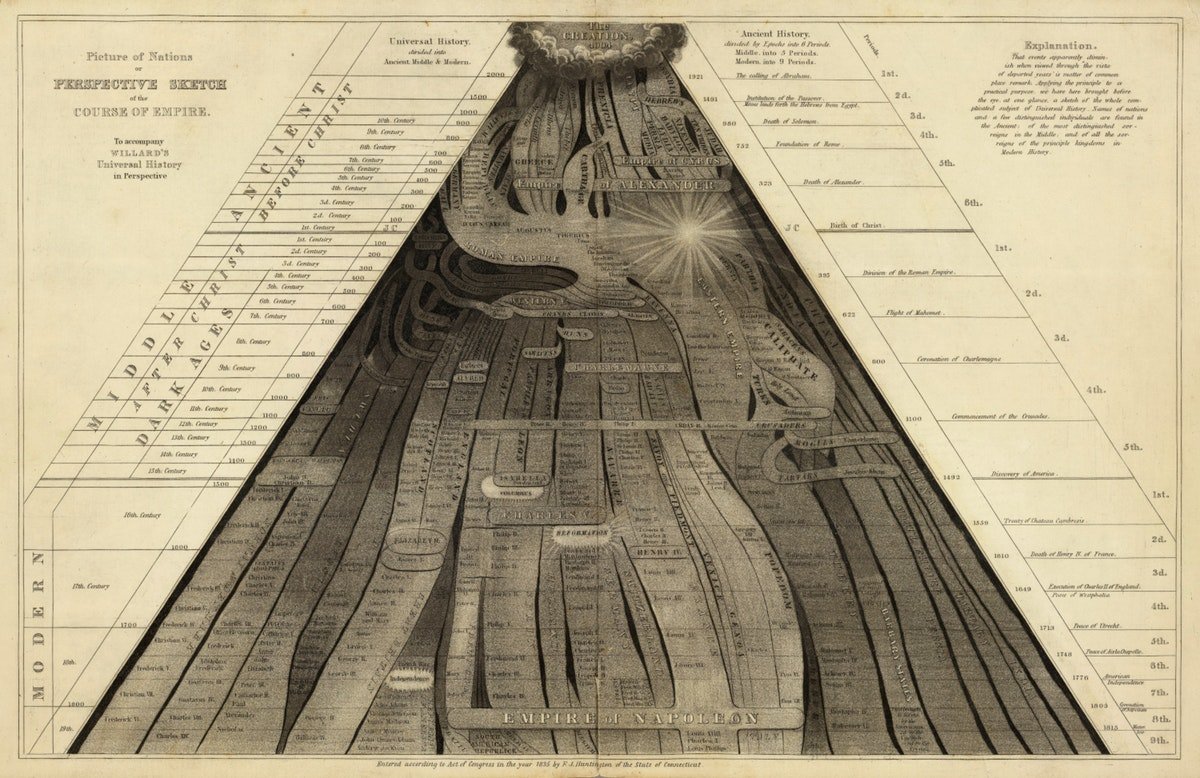
Image by: The Pari Center – Pari Center
The Temple of Time (1846): One of her most famous creations, this depicts universal history as a grand classical temple. The viewer stands at the entrance looking inward: columns represent centuries with key figures (statesmen, philosophers, warriors, etc.) labeled on the ceiling panels and pillars. The floor shows flowing empires and events receding into the distance toward "The Creation – 4004" BC on the far wall. It served as a "memory palace" for chronology, with a companion guide (Guide to the Temple of Time; and Universal History for Schools) explaining its use.
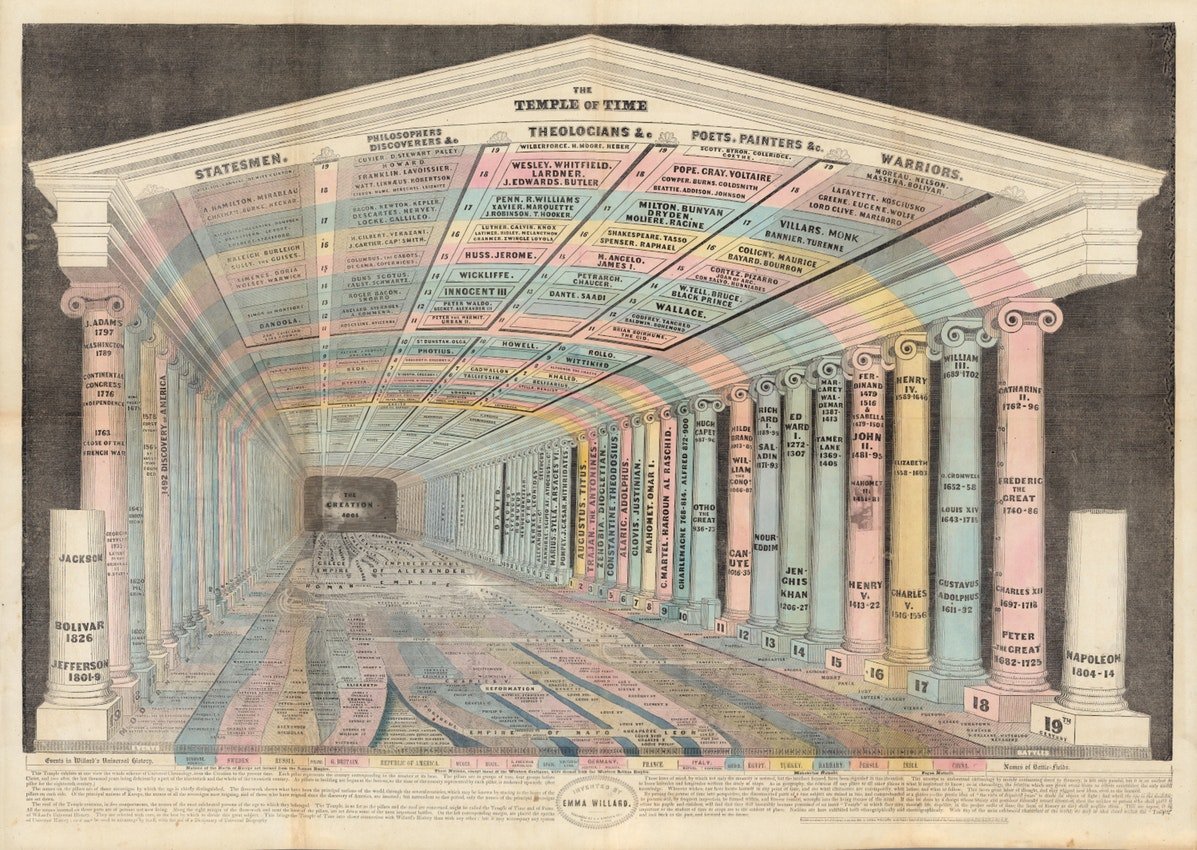
Image by: The Pari Center – Pari Center
Tree of Time / Historic Tree (e.g., Chronographer of American History, 1845): Focused on U.S. history from 1492 onward, this organic diagram shows time as a tree growing from roots (Columbus's discovery) into branching periods (e.g., settlement, Revolution, Constitution). Arcs mark centuries and eras, portraying American progress as natural and unified growth.
These visuals were revolutionary for education—patriotic, memorable, and influential in shaping how generations visualized history. Many are preserved in collections like the David Rumsey Map Collection or public domain archives. Willard's approach anticipated modern infographics by making "big data" of the past accessible and visually compelling.
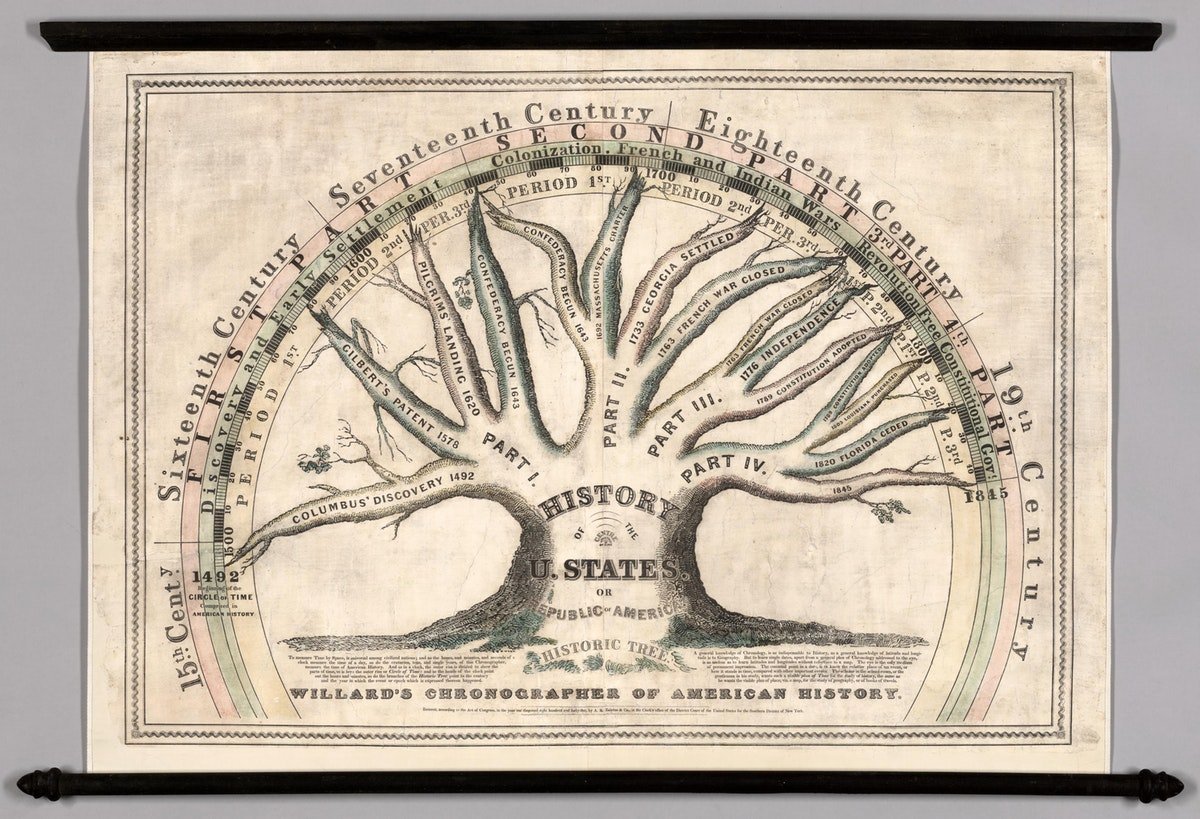
Image by: The Pari Center – Pari Center
"Rocked in the Cradle of the Deep"
"Rocked in the Cradle of the Deep" is Emma Willard's most famous and enduring poem, written around 1830–1839 (accounts vary slightly, with some sources noting it was composed during a transatlantic ocean voyage in 1839, reflecting the rocking motion of the sea). It was published in her 1831 collection The Fulfilment of a Promise.
The poem is a serene hymn-like piece expressing trust in divine protection amid the perils of the ocean, likening the sea's waves to a gentle cradle that lulls the speaker to peaceful sleep. It became hugely popular in the 19th century, often set to music as a song or hymn.
Full Lyrics (Standard Version)
Rocked in the cradle of the deep,
I lay me down in peace to sleep;
Secure I rest upon the wave,
For Thou, O Lord! hast power to save.
I know Thou wilt not slight my call,
As sleeps the infant 'neath its pall;
So calm the rocking billows keep,
Rocked in the cradle of the deep.
O'er me, when waves o'erwhelm the deep,
And wild winds sweep the foaming sea,
Thy watchful eye shall never sleep,
Thy guardian care shall shelter me.
The winds may howl, the tempests rave,
But calm my soul, for Thou art near;
Though billows roll, and surges heave,
I fear no ill, for Thou art here.
Rocked in the cradle of the deep,
I lay me down in peace to sleep;
Secure I rest upon the wave,
For Thou, O Lord! hast power to save.
(The exact wording varies slightly across publications, but this is the most common form found in hymnals and collections.)

Musical Setting and Legacy
In 1840, British composer Joseph Philip Knight set the poem to music, creating a popular parlor song/hymn in B-flat major. It was published by C.E. Horn in New York and became a staple in Victorian-era songbooks, often performed by vocalists. The melody is gentle and lullaby-like, emphasizing themes of faith, security, and the sublime power of nature/God.
The song was recorded multiple times in the 20th century and appeared in hymnals like Henry Ward Beecher's Plymouth Collection (1855). It's occasionally referenced in discussions of maritime literature or early American women's poetry.
Willard's other works (textbooks, timelines) were more directly tied to her educational mission, but this poem stands out as her lasting literary contribution—simple yet evocative, blending personal reflection with religious reassurance. It's a reminder of her multifaceted talents beyond education reform.
By her death at age 83 in Troy, New York, Emma Willard was hailed as one of America's most famous women. Her legacy endures in the ongoing push for gender equality in education.